10 April 2023

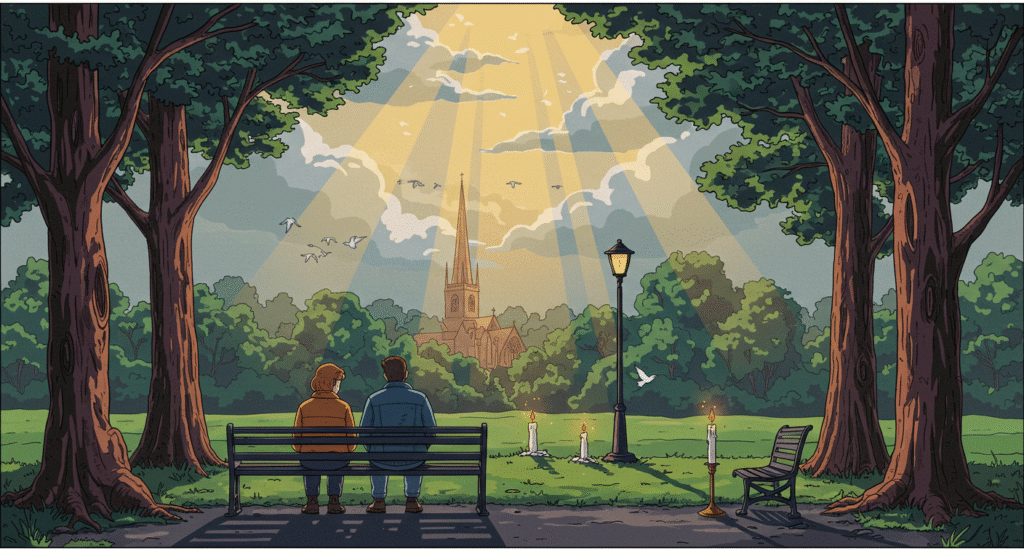
"A Britpop-style illustration symbolizing comfort in spirituality and faith during loss. Show a peaceful British setting — a sunlit park with tall trees, a church spire in the distance, and rays of light breaking through clouds. Figures in relaxed 90s Britpop clothing (parkas, denim jackets, Doc Martens) sit quietly on a bench or stand together, reflecting with calm expressions. Symbolic touches like birds in flight, candles, or beams of sunlight create a sense of hope and transcendence. Use bold outlines, warm muted retro colours, and a nostalgic 1990s British album cover style, blending everyday British life with subtle spiritual imagery to evoke peace, healing, and inner strength."

Finding Comfort in Spirituality: How Faith Can Help with Loss

Spirituality can play a crucial role in helping individuals find meaning amidst suffering and providing comfort during challenging times. For many, spirituality offers a connection to something larger than oneself, which can be a profound source of solace. This connection can help individuals navigate the complexities of grief and loss, offering hope and a sense of purpose.

Finding Comfort in Belief


One of the primary ways spirituality provides comfort is through the belief that a loved one is in a better place. This belief can be incredibly reassuring, especially during times of grief. The idea that a loved one is no longer suffering and is instead in a peaceful, positive state can help individuals cope with their loss. This sense of comfort can be a vital part of the healing process, providing a foundation of hope for the future.

Making Sense of Loss


Spirituality can also help individuals make sense of their loss. Many people find solace in the belief that everything happens for a reason and that the death of a loved one is part of a larger, divine plan. This perspective can offer comfort by suggesting that their loved one’s life had a purpose and that their death was not in vain. This belief can help individuals find meaning in their loss, transforming their grief into a more manageable and meaningful experience.

Emotional Sensitivity and Support


In times of distress, spirituality can heighten emotional sensitivity, making individuals more attuned to their feelings and the feelings of others. This heightened sensitivity can be both a challenge and a source of strength. On one hand, it can make the pain of loss more acute; on the other hand, it can deepen connections with others who are experiencing similar emotions.

Places of worship and spiritual communities can provide a supportive environment where individuals can share their experiences and connect with others who are going through similar losses. This sense of community can be incredibly powerful, helping individuals feel less isolated and more supported during difficult times. The shared experience of grief and the collective search for meaning can foster a sense of belonging and mutual understanding.

Beyond Organised Religion


It is important to note that spirituality does not necessarily mean adherence to a particular religion. While religion can be an important aspect of spirituality for many people, spirituality can also encompass a broader range of beliefs and practices. For some, spirituality might involve a connection to nature, meditation, or creative expression. These practices can offer a sense of peace and grounding, helping individuals navigate their grief in a way that feels authentic to them.

Nature and Meditation


For many, nature can be a profound source of spiritual comfort. The beauty and tranquility of natural settings can provide a sense of peace and connection to something larger than oneself. Spending time in nature, whether through walking, gardening, or simply sitting quietly, can help individuals find solace and perspective during difficult times.

Meditation is another practice that can be deeply spiritual and comforting. By focusing on the present moment and cultivating a sense of inner calm, meditation can help individuals manage their grief and find a sense of peace. Meditation can also provide a space for reflection and connection to one’s inner self, fostering a deeper understanding of one’s emotions and experiences.

Creative Expression


Creative expression can also be a powerful aspect of spirituality. Engaging in activities such as writing, painting, or music can provide an outlet for emotions and a way to process grief. These creative practices can help individuals explore their feelings and find meaning in their experiences. For many, the act of creating can be a spiritual practice in itself, offering a sense of connection and purpose.

The Role of Rituals


Rituals can play a significant role in spiritual practices, providing structure and meaning during times of loss. Whether they are religious rituals or personal ones, these practices can offer a sense of continuity and connection. Rituals can help individuals honor their loved ones and find a sense of closure. They can also provide a way to express emotions and connect with others who are sharing in the grief.

Spiritual Guidance and Counselling

Seeking spiritual guidance or counselling can be another important aspect of navigating grief. Spiritual counsellors or leaders can offer support and perspective, helping individuals find meaning and comfort in their loss. These professionals can provide a compassionate and understanding presence, offering guidance and support through the grieving process.

Finding Comfort in Spirituality: How Faith Can Help with Loss Read More »
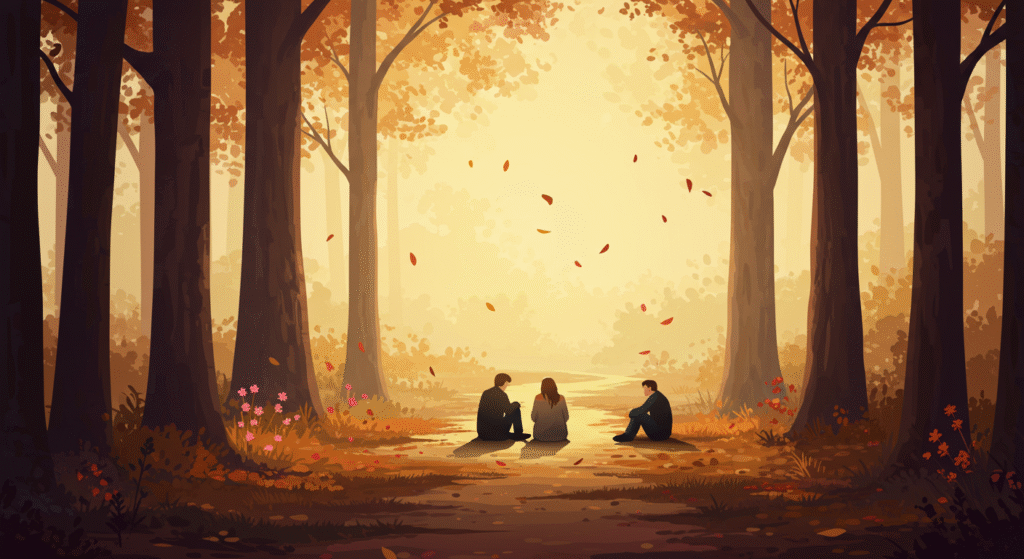
Britpop 1990s style vector art poster about"A serene, reflective scene symbolizing both death and mental health: a peaceful natural setting with soft, warm light filtering through tall trees, a winding path symbolizing life's journey, and gentle figures sitting together in conversation. Include subtle symbolic elements like a fading autumn leaf (representing mortality) and blooming flowers (representing growth and healing). The mood is calm, compassionate, and supportive, evoking openness, understanding, and emotional connection." — in the style of Blur or Oasis album artwork. The mood should be warm, hopeful, and dignified, balancing Britpop energy with sensitivity.

Breaking the Stigma: Discussing Death and Mental Health


Death and mental health are two topics that are often considered taboo or uncomfortable to talk about. However, it is crucial to break the stigma and have open and honest conversations about these issues. By doing so, we can better prepare ourselves and our loved ones for the inevitable and ensure that those struggling with mental health issues receive the support they need.

The Importance of Discussing Death


Death is a natural part of life, yet it remains a topic that many people avoid. In numerous cultures, death is considered a taboo subject, leading to discomfort and avoidance. However, avoiding discussions about death can make it more challenging to cope when it occurs. By having open and honest conversations about death, we can prepare ourselves and our loved ones for this inevitable part of life.

One way to break the stigma surrounding death is to talk about it in a safe and supportive environment. This could be with a trusted friend or family member, a therapist, or a support group. By discussing the fear and anxiety associated with death, we can begin to understand and accept it as a natural part of life. Additionally, conversations about death can help us plan for our own end-of-life care, ensuring that our wishes are honored and that our loved ones are prepared.

The Role of Mental Health in Our Lives


Mental health is another issue that is often stigmatized and avoided. Many people feel shame or embarrassment about their mental health struggles and, as a result, do not seek the help they need. However, mental health is as important as physical health, and it is essential to prioritize both.

Breaking the stigma around mental illness requires open and honest conversations about our own struggles and experiences. By talking about our mental health, we can reduce the shame and stigma associated with it. This can also help create a supportive environment where others feel comfortable seeking help for their mental health struggles.

Creating a Supportive Environment


To foster a supportive environment, it is important to educate ourselves about mental health and the resources available for those in need. This includes therapy, support groups, medications, and other treatments. By being informed, we can better support ourselves and others in managing mental health issues.

Supportive environments can be created in various settings, such as workplaces, schools, and communities. Employers can promote mental health awareness by providing resources and support for employees. Schools can implement mental health education programs to teach students about the importance of mental health and how to seek help. Communities can organize events and support groups to provide a safe space for individuals to share their experiences and receive support.

The Benefits of Open Conversations


Open conversations about death and mental health can have numerous benefits. For one, they can help individuals feel less isolated in their experiences. Knowing that others have similar fears and struggles can provide comfort and reassurance. Additionally, these conversations can lead to greater understanding and acceptance of death and mental health issues, reducing the stigma associated with them.

Moreover, open conversations can help individuals develop coping strategies and find meaning in their experiences. For example, discussing death can help individuals come to terms with their mortality and make the most of their time. Similarly, talking about mental health can help individuals identify triggers and develop strategies to manage their symptoms.

Practical Steps to Break the Stigma


Breaking the stigma around death and mental health requires practical steps that individuals and communities can take. Here are some suggestions:

  1. Educate Yourself and Others: Learn about death and mental health issues and share this knowledge with others. This can help dispel myths and misconceptions and promote understanding and acceptance.

  2. Create Safe Spaces: Encourage open and honest conversations about death and mental health in safe and supportive environments. This can be done through support groups, therapy sessions, or informal discussions with friends and family.

  3. Promote Mental Health Resources: Make information about mental health resources readily available. This includes information about therapy, support groups, medications, and other treatments.

  4. Challenge Stigmatizing Language: Be mindful of the language you use when talking about death and mental health. Avoid using stigmatizing terms and challenge others who do.

  5. Support Those in Need: Offer support to individuals who are struggling with death or mental health issues. This can be done by listening, offering practical help, or encouraging them to seek professional support.

Breaking the Stigma: Discussing Death and Mental Health Read More »

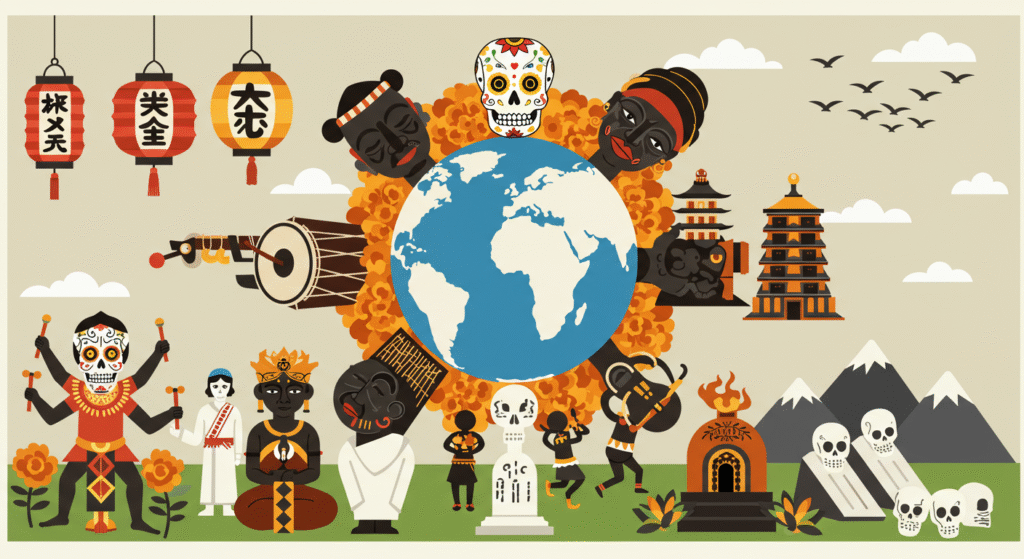
Britpop 1990s style vector art poster symbolizing the universality of death and mourning across cultures. A globe at the center surrounded by diverse cultural symbols of death rituals: Japanese lanterns, Mexican sugar skulls and marigolds, Ghanaian drums and dancers, Balinese cremation tower, Tibetan mountains with circling vultures. The imagery should feel unified and celebratory rather than somber, highlighting death as a shared human experience. Bold flat colors, sharp outlines, geometric stylization, high-contrast palette, minimal shading — designed in the energetic yet reflective style of 1990s Britpop album art (Blur, Oasis, Pulp). Iconic, eye-catching, and poster-like.

How different cultures around the world deal with death.

Death is a common human experience that transcends culture, religion and geography. Despite the different beliefs, customs and practices related to death, the themes of grief, loss and death are everywhere. This article takes a closer look at the world’s death culture, examining how different cultures approach death and mourning, and how these practices reflect larger traditions and beliefs. Cultures around the world have unique ideas about death. Many Western cultures avoid it, while Eastern cultures consider death a natural part of life. African cultures see death as a journey, and the afterlife is often celebrated. In the United States, cremation practices have begun to include funeral services, and there is a growing push for more traditional ways to bring about death. Cultural values and beliefs play an important role in death rituals. For example, cultures in which death is accepted as a part of life have less anxiety and place more emphasis on celebrating life.

1. Japan - Obon Festival

In Japan, the Buddhist custom of Obon, celebrated in August, reflects the belief that the spirits of the deceased return to visit their families during this time. To honor these spirits, families light lanterns and place them on the graves of their loved ones, guiding the spirits back to the world of the living. A significant part of the celebration is the traditional Bon dance, which communities perform together to welcome the spirits.

How the Japanese celebrate death Britpop 1990s style vector art of Japan’s Obon Festival. Vibrant lanterns floating in the night sky, glowing softly against deep blues and purples. Families gathered near graves, lighting lanterns with reverence. A lively Bon dance in the background, dancers in yukata moving in rhythm. Bold flat colors, sharp outlines, geometric stylization, and poster-like composition reminiscent of Blur and Oasis album covers. Fusion of Japanese tradition with 1990s Britpop graphic energy, minimal shading, high-contrast palette, iconic and eye-catching.
Mexico - Day of the dead Britpop 1990s style vector art of Mexico’s Día de los Muertos. A vibrant cemetery scene with glowing marigold flowers, candles illuminating the night, and colorful sugar skulls placed on decorated graves. Families gathered joyfully, creating elaborate altars with food, drinks, and offerings for ancestors. The atmosphere is festive yet reverent, with papel picado banners fluttering overhead. Bold flat colors, striking outlines, geometric stylization, and poster-like energy reminiscent of Blur and Oasis album covers. Fusion of Mexican tradition with 1990s Britpop graphic design: high-contrast palette, minimal shading, iconic and eye-catching.

2. Mexico - Día de los Muertos (Day of the Dead)

In Mexico, Día de los Muertos, or the Day of the Dead, is a vibrant celebration held from October 31 to November 2. During this time, it is believed that the souls of the dead return to the world of the living. Families create elaborate altars in their homes, adorned with marigold flowers, candles, and offerings of food and drink that the deceased loved. Cemeteries become lively places where families clean and decorate graves, leaving offerings and spending time with the spirits of their ancestors.

3. Ghana - The Adowa Ceremony

In Ghana, particularly among the Akan people, death is marked by the Adowa ceremony, a vibrant celebration of life. This ceremony, which can last several days, involves drumming, singing, and dancing to honor the deceased. Rather than being somber, the Adowa is a joyful occasion where the community comes together to celebrate the life and legacy of the person who has passed.


Britpop 1990s style vector art of Ghana’s Adowa funeral ceremony. A vibrant community gathering filled with joyful drumming, singing, and energetic dancing. Figures in traditional Ghanaian attire moving rhythmically, surrounded by drums and musicians. Bright textiles, bold patterns, and dynamic movement convey celebration rather than mourning. The atmosphere is communal, festive, and full of life. Designed in Britpop poster style reminiscent of Blur and Oasis album covers — bold flat colors, sharp outlines, geometric stylization, minimal shading, and a high-contrast palette for a striking, iconic look.
Britpop 1990s style vector art of Bali’s Ngaben cremation ritual. A grand, ornate sarcophagus shaped like a mythological creature being carried in procession by villagers in traditional Balinese attire. Flames rising as the sarcophagus burns in a public ceremony, with offerings and intricate temple architecture in the background. The scene symbolizes the soul’s liberation and return to the natural world, with the sea on the horizon. Designed in bold Britpop poster style reminiscent of Blur and Oasis album covers — flat, high-contrast colors, sharp outlines, geometric stylization, minimal shading, and an iconic, eye-catching composition.

4. Indonesia - Ngaben Cremation Ritual

In Bali, Indonesia, the Hindu population observes a unique cremation ritual known as Ngaben. The body of the deceased is placed in a specially crafted sarcophagus, often shaped like an animal or mythological creature, which is then burned in a public ceremony. The ritual is believed to liberate the soul from the physical body, allowing it to begin its journey to the afterlife. The ashes are typically scattered in the sea, symbolizing the soul’s return to the natural world.

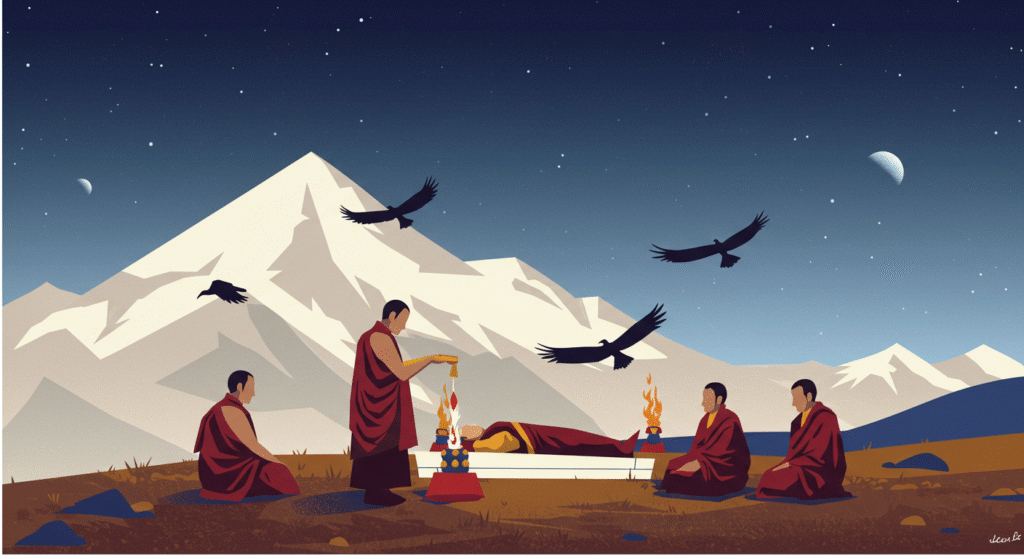
5. Tibet - Sky Burial

In Tibet, the practice of Sky Burial is a deeply spiritual Buddhist tradition. In this ritual, the body of the deceased is offered to vultures, symbolising the return of the body to the natural cycle of life and death. This practice reflects the belief in impermanence and the importance of helping the soul transition smoothly into the afterlife. The Sky Burial is both a practical and sacred act, rooted in the region’s unique spiritual and environmental context.

Britpop 1990s style vector art of Tibet’s Sky Burial ritual. A serene mountain landscape under a vast sky, with monks in traditional robes performing sacred rites. Vultures circling and descending, symbolizing the body’s return to nature. The scene conveys both reverence and impermanence, rooted in Buddhist spirituality. Designed in bold Britpop poster style reminiscent of Blur and Oasis album covers — flat, high-contrast colors, sharp outlines, geometric stylization, minimal shading, and striking, iconic composition with a contemplative yet powerful mood.

You can read more about the Mexican festival “Day of the Dead” with this books: 

https://fivebooks.com/best-books/regina-marchi-on-the-day-of-the-dead/

How different cultures around the world deal with death. Read More »